
How to Reach Out to Content Creators and Journalists About Your Upcoming Indie Game (Without Being Ignored)
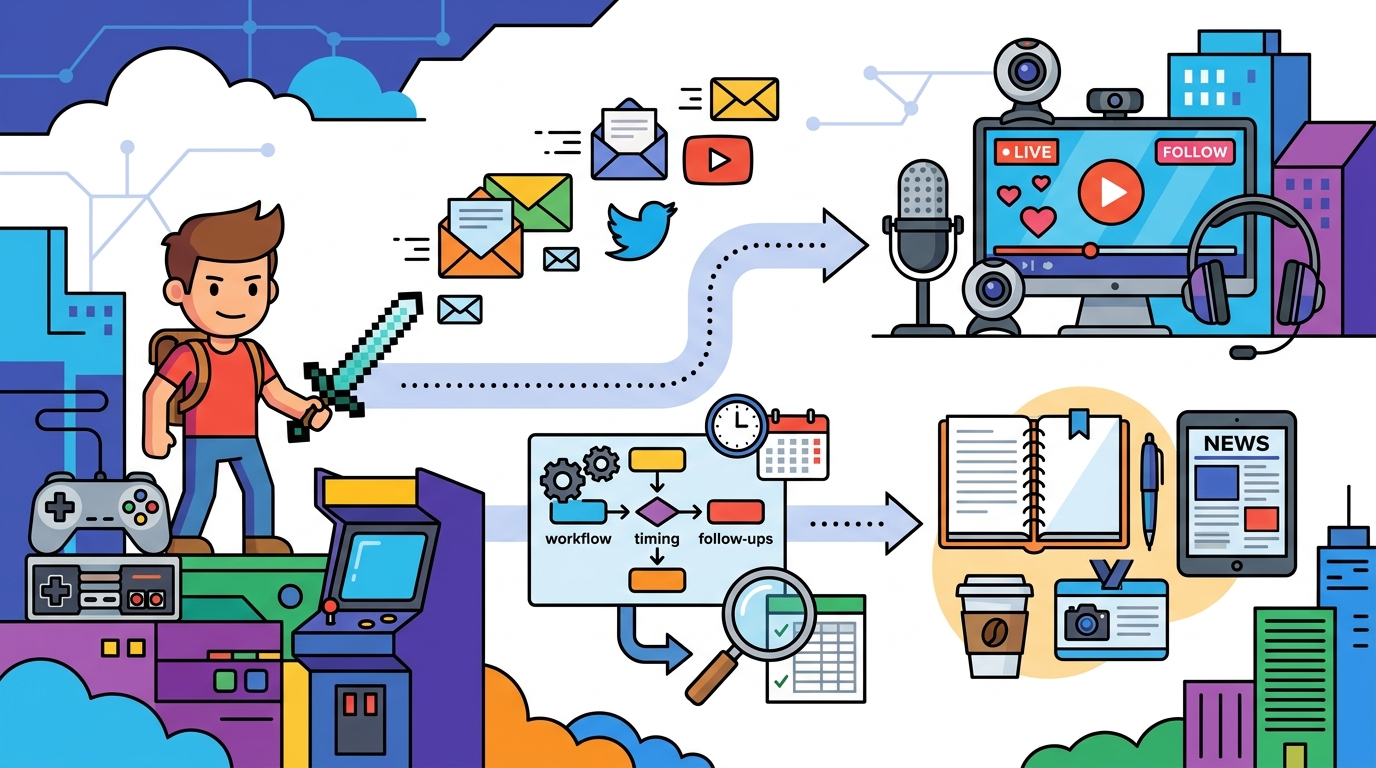
Reaching out to creators and journalists is one of the fastest ways to turn an “upcoming indie game” into a game people actually talk about.
But most pitches get ignored because they’re too long, too vague, or arrive at the wrong time. This guide breaks down a practical outreach workflow you can reuse for every announcement, demo drop, and launch.
Know who you’re pitching (and why they’d care)
Before you write a single email, decide what kind of coverage you’re trying to earn: a news post, a preview, a review, a Let’s Play, a TikTok clip, or a stream segment.
Each format has different needs. Journalists need a clear angle and assets; creators need a game that will perform well for their audience in a short, watchable format.
Build a “best fit” list instead of a giant list
Outreach works better when you send 30 great emails than 300 generic ones. Your goal is relevance, not volume.
Genre fit: Do they cover your genre regularly (cozy, horror, roguelike, narrative)?
Audience fit: Are their viewers the kind of players who wishlist and buy games like yours?
Platform fit: If your game shines in short clips, prioritize TikTok/Shorts creators. If it’s story-heavy, prioritize longform YouTube and press.
Size fit: Don’t only chase huge creators. Mid-size and niche creators often convert better and respond more.
Do 5 minutes of research per contact
You don’t need to write a personalized essay, but you should be able to answer: “Why this person?”
Look for a recent video/article that matches your game’s vibe, a recurring series they run (e.g., “Steam Next Fest demos”), or a theme they like (speedruns, cozy management, survival crafting).
Get your materials ready before you hit send
Most outreach fails because the recipient can’t quickly understand the game, see good footage, or access a build.
Make it easy to say “yes” in under two minutes.
What you need at minimum
Landing page: A clean page with trailer/GIFs, short pitch, features, and clear call-to-action (wishlist, demo, newsletter).
Press kit: Logos, screenshots, trailer link, fact sheet, team bio, and contact info.
Playable build plan: Demo on Steam, itch key, or private key distribution for creators/press.
One-sentence hook: A crisp “what it is” line that makes your game easy to categorize.
GameTrowel helps here by generating a professional press kit and landing page quickly, then keeping your assets organized so every pitch points to the same up-to-date source.
Create two versions of your pitch: press and creators
You can reuse the same core info, but you should change the framing.
Press angle: “Here’s why this is newsworthy now.”
Creator angle: “Here’s why this will make a good video/stream.”
Write a pitch that gets opened and understood fast
Think of your message like a store page: skimmable, specific, and focused on the recipient.
Keep it short enough to read on a phone. If you need more detail, put it on the press kit page.
Subject lines that work (examples)
Creators: “Key offer: [Game Name] — [hook] (demo available)”
Press: “Preview/review: [Game Name], a [genre] about [unique twist]”
Event timing: “Steam Next Fest demo: [Game Name] — press/creator keys”
Local angle: “Indie from [country/city]: [Game Name] launches [date]”
A simple pitch structure (copy/paste template)
Line 1: Who you are + what you’re offering.
Line 2: The one-sentence hook (what it is + why it’s different).
Line 3: 2–3 bullet features that translate to content (moments, challenges, systems).
Line 4: Links (Steam page, trailer, press kit) and the ask (key, preview, coverage, stream).
Line 5: Availability + thank you.
Creator pitch example
Hey [Name] — I’m [Dev] from [Studio]. I’d love to offer you a key for [Game Name] (PC), and I think it fits your audience.
[Game Name] is a [genre] where you [core verb] — but the twist is [unique hook].
[Feature that creates moments]: e.g., “Every run ends with a 60-second escape sequence.”
[Feature that’s easy to explain on video]: e.g., “Deckbuilding spells with physics-based combos.”
[Feature that supports replayability]: e.g., “Daily challenges + leaderboard seeds.”
Trailer: [link] | Steam: [link] | Press kit: [link]
If you’d like a key (or a demo code), I can send it over right away. Thanks for your time!
Press pitch example
Hi [Name] — I’m [Dev] from [Studio]. I’m reaching out because we’re announcing [Game Name], a [genre] about [hook], launching [date/window].
We have a [demo/preview build] available now, plus screenshots, trailer, and a full press kit here: [link].
If you’re interested, I can provide a key and any extra info (quotes, roadmap, interview availability).
Timing: when to reach out (and when not to)
Great pitches still fail if they hit inboxes at the wrong time. You want to align your outreach with moments that are naturally coverable.
High-response moments for indie games
Announcement (with trailer + Steam page live)
Demo release (especially for Steam Next Fest)
Major update (new biome, co-op mode, big content drop)
Launch date reveal (with a strong new trailer)
Review/preview keys (1–2 weeks before launch for creators; earlier for some press)
A simple outreach timeline
6–8 weeks before a demo/event: Start building your list and warming up contacts. Follow creators, comment genuinely, and learn what they like.
2–3 weeks before: Send your first wave of targeted emails with a clear “why now.”
3–5 days before: Follow up once with new info (updated build, new trailer, date reminder).
During the event: Keep it light. Share clips, retweet coverage, and offer help fast (keys, troubleshooting, assets).
With GameTrowel’s launch timeline planner, you can map these beats and reuse the same checklist for every milestone so outreach doesn’t become a last-minute panic.
Keys, builds, and access: remove friction
Creators and press are busy. If they have to ask three times for a key, many won’t bother.
Decide your access policy upfront and make it clear in the email.
Best practices for key distribution
Offer the right platform: Steam keys for most, but consider itch builds for fast access.
Include embargo info clearly: If there’s an embargo, put it in bold and keep it simple.
Provide troubleshooting: A short “if the build breaks, reply here” line increases confidence.
Track who got what: Prevent double-sends and know who needs follow-up.
GameTrowel’s key distribution and request management helps you send keys safely, track requests, and avoid messy spreadsheets.
Follow-ups that don’t feel spammy
Following up is normal. The key is making your follow-up useful, not guilt-driven.
Follow-up rules
Wait 4–7 days for the first follow-up (unless the timing is urgent like Next Fest).
Follow up once (twice max for time-sensitive beats).
Add something new: a fresh trailer, a demo update, a streamer-friendly mode, a press quote, or a new date.
Make the “no” easy: “No worries if it’s not a fit.”
Follow-up example
Hey [Name] — quick bump in case this got buried. We just updated the demo with [new feature] and added [accessibility option/controller support].
If you’d like a key, I can send it today. If it’s not a fit, no worries at all.
Make your game easy to cover (the “content checklist”)
Even if someone loves your concept, they may skip it if it’s hard to turn into a good post or video.
Design and present your game with coverage in mind.
What creators look for
A strong first 5 minutes: A hook, a surprise, or a clear goal.
Readable UI and audio: Especially for streams.
Shareable moments: Scares, fails, discoveries, funny physics, tough choices.
Clear run length: “A run takes 20–30 minutes” is useful for planning.
What journalists look for
A clear angle: What makes this notable compared to similar games?
Clean facts: Platforms, release window, price (if known), team size, engine (optional).
High-quality assets: Screenshots that show UI and gameplay, not only key art.
Quotable lines: A short dev quote about inspiration or design goals.
GameTrowel’s press kit generator and landing page templates help you present these details consistently, while the analytics dashboard shows which links and beats are actually driving wishlists.
Track results and iterate (so outreach gets easier)
Outreach is a loop: pitch, measure, improve. If you don’t track what happened, you’ll keep repeating the same mistakes.
What to track in a simple outreach CRM
Contact info (email, channel, socials)
Status (pitched, replied, key sent, covered, declined)
Links to coverage (articles, videos, VODs)
Notes (what they liked, preferred genres, best contact method)
With GameTrowel, you can combine press & media outreach (curated contact database) with media monitoring across YouTube, Twitch, TikTok, Reddit, and press outlets to catch coverage you might otherwise miss.
Improve your pitch using real signals
If opens are low, test shorter subject lines and clearer “demo available” timing.
If replies are polite but uninterested, your hook may be too generic. Tighten the unique twist.
If creators take keys but don’t post, your first 10 minutes might be slow or confusing.
If coverage happens but wishlists don’t move, your Steam page and call-to-action may need work.
Steam-specific tuning matters a lot. Tools like GameTrowel’s Steam tag analysis and competitor research can help you position your game so the traffic you earn converts into wishlists.
Common outreach mistakes (and quick fixes)
Mistake: Sending a wall of text. Fix: Keep it to 120–200 words plus 2–3 bullets.
Mistake: No clear ask. Fix: Ask for a key request, preview, or coverage explicitly.
Mistake: “We made a game, please cover it.” Fix: Lead with the hook and why their audience will care.
Mistake: Broken links and missing assets. Fix: Use one press kit link that stays updated.
Mistake: Mass emailing without relevance. Fix: Segment by genre, platform, and content style.
Ready to streamline your outreach and launch?
Ready to streamline your game launch? GameTrowel brings landing pages, press kits, outreach, keys, monitoring, and analytics together in one platform — get started free.
Ready to launch your indie game?
GameTrowel gives you everything you need — landing pages, press kits, outreach tools, media monitoring, and more — all in one platform.