
Why Indie Game Developers Need a Mailing List (and How to Start Today)
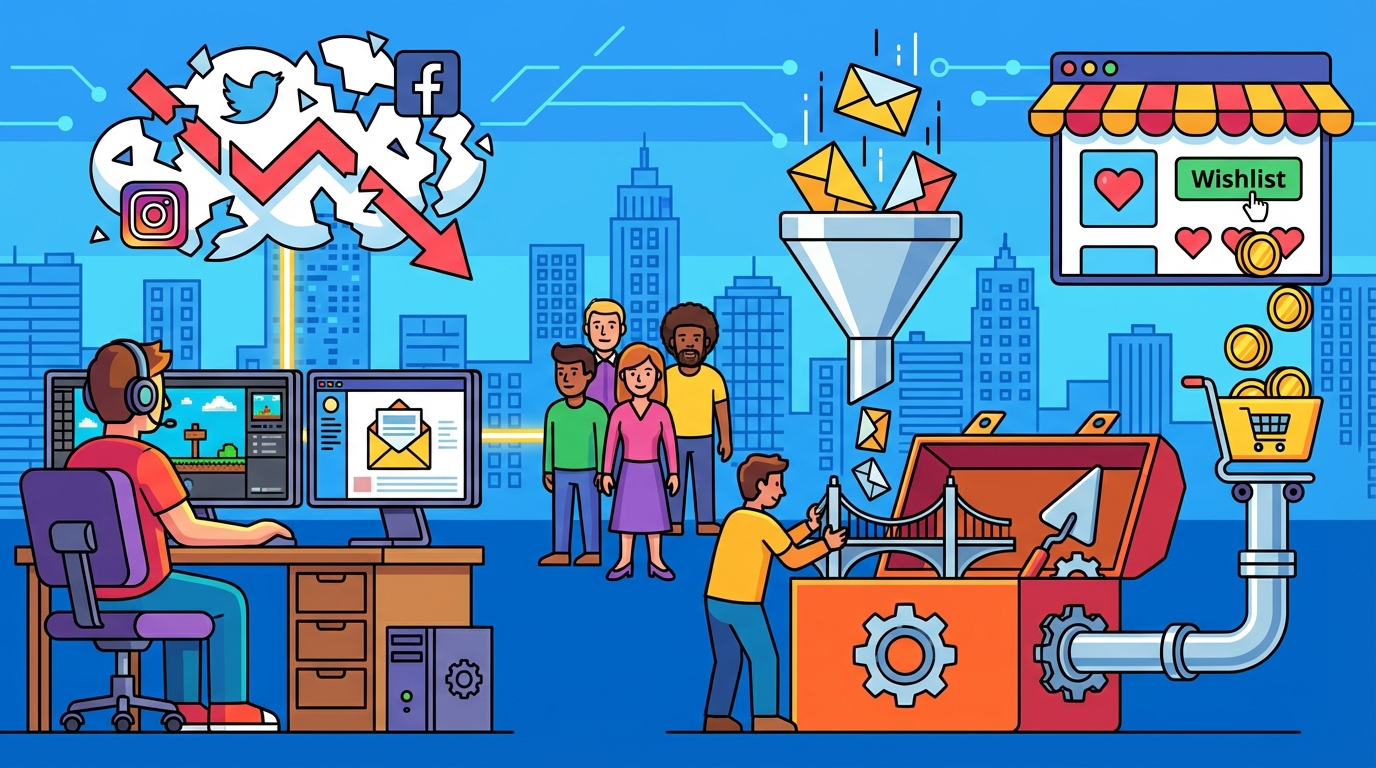
Why game developers need a mailing list (and not just social)
Algorithms change, platforms come and go, and discoverability gets tougher every year. Your mailing list is the one channel you truly own.
It gives you direct, reliable access to players who’ve said, “I want to hear from you.” That clarity turns casual interest into wishlists, demo downloads, and sales.
What a mailing list actually does for your game’s success
You own the channel
Followers on social media are rented attention. Email subscribers are owned attention you can reach anytime. If an account gets throttled or a platform sunsets a feature, your list still works.
Ownership also means portability. Switching engines, storefronts, or even rebranding? Your audience moves with you.
Better conversion than the social feed
Social posts are easy to miss and even easier to forget. A focused email with a single call-to-action gives players a clear next step: wishlist, download the demo, or join the playtest.
When it’s launch week, clarity beats cleverness. Email delivers that clarity.
Algorithm-proof at crucial moments
Steam page going live, a demo dropping during a festival, price promo starting Friday—those are time-sensitive. Email cuts through the noise and lands where players look every day: the inbox.
When you need guaranteed reach, a mailing list is your safety net.
Social helps fans discover you. Email helps fans decide.
Compounds over time
Each devlog, teaser, or small update nudges players forward: newsletter signup → wishlist → demo → review → DLC. The list lets you run that loop repeatedly, growing momentum without starting from zero.
That compounding effect is how indie games punch above their weight.
What to send (and when)
Pre-announcement: building curiosity
Start collecting emails before you name the game. Share mood, themes, and a tiny peek at the hook.
Content ideas: art drops, a 30-second GIF of your core mechanic, a short dev note about inspiration.
Subject lines: "One gif, one mechanic," "Is this cozy or creepy?"
Steam page live: turn hype into wishlists
Announce the page with a clear CTA and a single hero image or short clip. Make “Wishlist on Steam” the only button.
Content ideas: 2–3 screenshots, 10-second hook clip, what makes your game different, wishlist button.
Subject lines: "We’re live on Steam—wishlist today," "Does this boss make the cut?"
Playtest/alpha/beta: invite participation
Email is perfect for controlled playtest waves. You can explain the goal, collect feedback, and thank testers properly.
Content ideas: playtest dates, how to join, what you’re measuring, a feedback form link.
Subject lines: "Want in on the first build?", "Break our game (we dare you)"
Launch: focus on one action
On launch day, keep the email short with a single storefront link matching the player’s platform. Add a reminder email 48 hours later.
Content ideas: launch trailer, store link, a brief thank-you note, clear ask to review if they enjoyed it.
Subject lines: "It’s out!", "Your next cozy evening is here"
Post-launch: keep the fire burning
Share meaningful updates—patches, DLC, events, speedrun contests, and community spotlights—to turn buyers into advocates.
Content ideas: roadmap check-ins, mod highlights, soundtrack news, discount alerts.
Subject lines: "New difficulty mode just dropped," "Update 1.1: photo mode + QoL"
How to grow your list without being spammy
Add signup forms to your site and landing pages. Offer a small perk: a desktop wallpaper pack, OST preview, or early demo access window.
Link your newsletter from your Steam page’s Website field, community announcements, and pinned discussions. Drive readers to a simple signup page.
Place the link in your trailer description, Itch page, forum signatures, and a pinned tweet. Use the same short URL everywhere to track performance.
In Discord, pin a "Get dev updates by email" post in #announcements. Some fans prefer inbox over chat scrollback.
At events, use a tablet or QR code to a mobile-friendly signup. Keep the form to two fields: email + favorite platform.
Run transparent giveaways where email opt-in is optional, never required. Trust beats tactics.
Comply with privacy laws: include an unsubscribe link and physical address, and consider double opt‑in for EU audiences. This isn’t legal advice—check your obligations.
Never buy lists. Low trust and deliverability issues will sink your reach.
Offer a clear reason to subscribe.
Make signup frictionless across your touchpoints.
Send useful updates on a predictable cadence.
Make emails people love to read
Keep it skimmable: short paragraphs, one main CTA, and a single hero visual. Inbox time is precious.
Write like a human. Share a quick story from development—what surprised you this week?
Design for mobile first. Use real text, not image-only posters, and add alt text to key images.
Subject lines: aim for curiosity or value, not clickbait. Test formats like question, number, or benefit.
Cadence: monthly in early dev, twice monthly in the six weeks before a big beat (demo, festival, launch), then monthly post-launch.
Include platform-specific links (Steam, Epic, console pages) so players never hunt for the right store.
Set a friendly reply-to. Good replies turn into testimonials and UX fixes.
Track what matters (and ignore vanity metrics)
Opens and clicks are directional, but what you really want is downstream impact: wishlists, demo downloads, playtest signups, and sales.
Tag your links with consistent UTM parameters: source=email, campaign=demo_june, etc. That way you can attribute wishlists and purchases accurately.
Watch growth rate, click-through to your store page, wishlists per send, and churn (unsubscribes). If churn spikes, adjust cadence or value.
Test one variable at a time—subject line, hero image, or CTA placement—so you know what moved the needle.
Prune truly inactive subscribers periodically to protect deliverability.
Where GameTrowel helps
GameTrowel brings list-building and launch workflows under one roof, so you spend less time wiring tools together and more time building your game.
Mailing list management + embeddable signup forms: Spin up a clean newsletter in minutes and drop forms on your site or landing page. No glue code required.
Landing page builder: Use genre-themed templates (cozy, horror, retro, sci‑fi) with a built-in newsletter block to convert trailer views into subscribers.
AI-powered content generation: Draft subject lines, devlog blurbs, and CTA variations quickly, then edit to taste.
Steam tools + analytics: Tie campaign clicks to wishlist growth and track competitors for context. See which emails actually moved your numbers.
Social scheduling: Cross-post your newsletter announcement to Twitter/X, Reddit, and more, so fans who missed email still see the beat.
Press kit + outreach: Keep your fan newsletter separate from media outreach. Use the press kit generator and curated journalist/creator database for targeted press sends when appropriate.
Launch timeline: Follow guided tasks (like setting up a custom sending domain and creating your pre‑launch welcome email) so nothing slips through the cracks.
Common pitfalls to avoid
Adding journalists or creators to your fan list without consent. Keep press contacts in a separate, explicit press list.
Image-only emails. Many clients block images by default; always include real text and a clear button.
Irregular cadence. Going silent for months then blasting three times in a week erodes trust. Pick a pace you can keep.
Too many asks in one email. One message, one CTA.
No onboarding. New subscribers should get a short welcome email that sets expectations and highlights your best trailer or GIF.
Skipping deliverability basics. Use a professional from-address on your domain and follow your provider’s guidance for SPF/DKIM/DMARC.
Ready to streamline your launch?
Own your audience, send better updates, and measure the impact. GameTrowel brings your mailing list, landing pages, Steam tools, and analytics together—get started free.
Ready to launch your indie game?
GameTrowel gives you everything you need — landing pages, press kits, outreach tools, media monitoring, and more — all in one platform.