
Low-Budget Paid Ads Experiments for Steam: Validate Positioning, Improve Capsule Art, and Measure Wishlist Conversion (Meta + Reddit)
Paid ads can be a fast way to test whether your Steam page and positioning resonate, but most indie teams burn money by scaling too early or measuring the wrong thing.
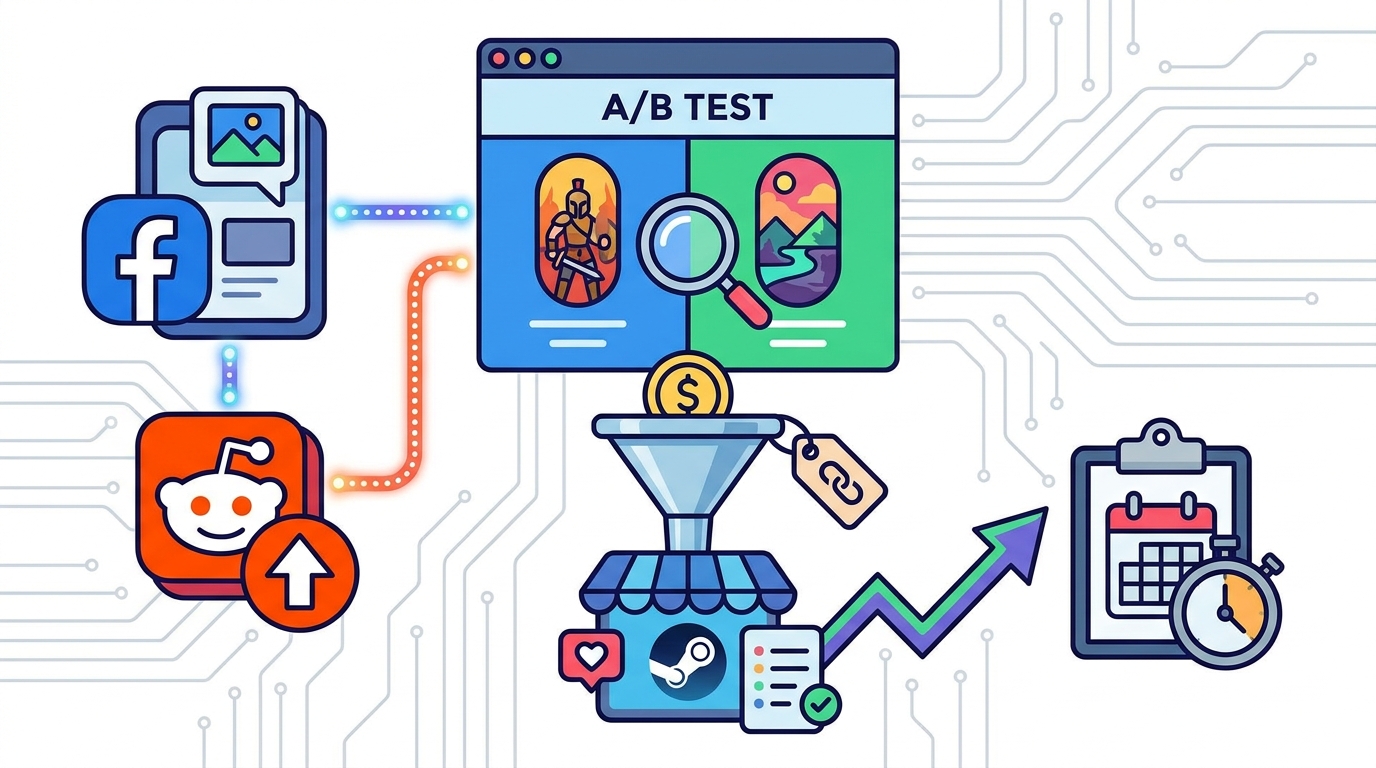
This tutorial shows a controlled, low-budget experiment framework for Meta and Reddit ads that focuses on learning: which message and capsule art earn clicks, and which clicks likely turn into wishlists.
What you can (and can’t) learn from a $50–$200 test
With a small budget, you’re not “buying wishlists” so much as buying data about your positioning, creative, and Steam page conversion.
You can compare creatives, audiences, and hooks using CTR/CPC and estimate wishlist conversion. You usually can’t get perfectly attributed wishlist counts because Steam doesn’t provide pixel-level ad attribution.
Prerequisites: get your Steam page ready before spending $1
1) Steam page readiness checklist (minimum viable)
- Capsule art that matches genre expectations (even if it’s a first draft).
- Trailer or short gameplay clip (10–30 seconds is fine) above the fold.
- First 5 screenshots show core gameplay loop, not menus or logos.
- Short description communicates genre + fantasy + differentiator in 1–2 sentences.
- Tags reflect what players search for (avoid “aspirational” tags that don’t match gameplay).
- Clear call-to-action: “Wishlist now” in the trailer end card and key art where appropriate.
If your page is missing these, ads will mostly measure “how expensive it is to send people to a confusing page.” Fix the page first.
2) Build tracking links with UTMs (so you can segment traffic)
Steam won’t show you ad-level conversions, so your best friend is consistent UTM naming and clean experiment structure.
Create one unique URL per ad set using a strict convention:
steam_url?utm_source=meta&utm_medium=paid&utm_campaign=wl_test1&utm_content=capA_hook1&utm_term=aud_interest_rpg
- utm_source: meta, reddit
- utm_campaign: wl_test1 (keep constant per experiment week)
- utm_content: creative identifier (capsule version + hook)
- utm_term: audience identifier (interest/subreddit)
In GameTrowel, you can generate and manage UTM link sets for campaigns, then tie them to your Steam wishlist tracking and analytics dashboard so you don’t lose naming consistency across platforms.
3) Baseline your “organic” wishlist rate before testing
Record your typical daily wishlists and Steam traffic sources for the last 7 days. This gives you a baseline so you can detect lift during the test window.
Even a rough baseline helps you avoid false conclusions from normal day-to-day variance.
Experiment design: 2–3 controlled tests that actually teach you something
Your goal is to change one variable at a time and keep everything else stable. Most indie ad tests fail because they change audience, creative, copy, and landing page all at once.
Test 1 (Creative): capsule art + hook vs. capsule art + hook
This is the highest-leverage test because your capsule and first impression drive both click quality and Steam conversion.
- Audience: keep identical (one interest cluster on Meta, one subreddit cluster on Reddit).
- Variable: creative only (two capsule versions, or two hooks with same capsule).
- Ads: A and B, same format, same destination URL structure (different utm_content).
Example: Cozy farming roguelite.
- Creative A: Capsule shows character + farm + “Deckbuild Your Harvest” hook.
- Creative B: Capsule shows monster + crops + “Fight by Planting” hook.
Test 2 (Audience): same creative, two audiences
Once you have a “good enough” creative, test whether your targeting is too broad or misaligned.
- Variable: audience only.
- Creative: lock one winner from Test 1.
- Goal: find the cheapest qualified click (not the cheapest click overall).
Meta audience examples:
- Audience A: interests like “Steam,” “PC gaming,” plus your genre comps (e.g., Hades, Slay the Spire).
- Audience B: narrower “genre-first” cluster (e.g., “deck-building,” “roguelike,” “tactical RPG”).
Reddit audience examples:
- Audience A: 3–5 tightly relevant subreddits.
- Audience B: slightly broader adjacent subreddits (still genre-aligned).
Test 3 (Message): value prop vs. feature list
If clicks are fine but wishlists don’t move, your positioning may be unclear. Test copy that frames the fantasy versus copy that lists mechanics.
- Message A: fantasy/outcome (e.g., “Build a haunted hotel that feeds on fear”).
- Message B: mechanics (e.g., “Manage staff, upgrade rooms, and outsmart exorcists”).
Platform setup: Meta and Reddit without overcomplicating it
Meta (Facebook/Instagram): keep it simple
- Objective: Traffic (for early tests) or Sales/Conversions (only if you have a reliable off-Steam conversion event, which most don’t).
- Placements: start with Advantage+ placements, but watch for junk placements if CTR is weirdly high and quality is low.
- Optimization: Link clicks (early) or Landing page views (if volume allows).
- Creatives: 1:1 and 9:16 variants if you can, but keep the concept identical.
Use a single campaign with 2 ad sets for audience tests or 1 ad set with 2 ads for creative tests. Don’t create 12 ad sets “just in case.”
Reddit Ads: target communities, not demographics
- Objective: Traffic.
- Targeting: subreddit-based targeting first; interest targeting second.
- Creative: static image + strong headline often beats generic video for early validation.
- Frequency: watch fatigue; small subreddits burn out fast.
Reddit can be noisy and sometimes botty. Your test design needs stop rules and sanity checks (covered below).
Budgeting and KPIs: what to measure when Steam won’t attribute conversions
Recommended budget ranges
- Minimum viable: $50–$80 total (only for creative CTR/CPC signal).
- Useful: $120–$200 total (enough to compare 2–3 variants with less noise).
- Per ad set per day: $5–$15 is usually adequate for early learning.
Core KPIs for low-budget Steam tests
- CTR (link click-through rate): measures resonance of creative + hook.
- CPC (cost per click): measures efficiency of reaching the right people.
- Wishlist-per-click estimate (WPC): your proxy for conversion quality.
How to estimate wishlist-per-click (WPC)
Because you can’t attribute perfectly, you’ll estimate using lift over baseline during the test window.
- Record baseline daily wishlists (7-day average) before the test.
- During the test, record daily wishlists and total ad clicks (from each platform).
- Compute incremental wishlists: (test period wishlists) − (baseline expected wishlists).
- Estimate WPC: incremental wishlists / ad clicks.
This is imperfect, but it’s directionally useful when you run short, controlled windows and avoid overlapping campaigns.
GameTrowel helps here by centralizing your UTM traffic grouping and Steam wishlist tracking so you can compare “meta paid” vs “reddit paid” windows without spreadsheet drift.
Interpreting noisy data (without fooling yourself)
Use “directional thresholds,” not statistical purity
With small budgets, treat results as a filter. You’re looking for clear winners/losers, not a publication-grade conclusion.
- Creative winner signal: CTR is consistently higher by ~30%+ with similar CPC.
- Audience winner signal: similar CTR but meaningfully lower CPC and better WPC estimate.
- Bad traffic signal: very low time on page (if you can infer), unusually high CTR with zero wishlist lift, or suspicious click patterns.
Sanity checks for bot/junk traffic
- Reddit: sudden bursts of clicks with no corresponding Steam traffic lift can indicate low-quality placements.
- Meta: if CTR is high but your Steam page metrics don’t move at all, check placements and creative mismatch.
- Both: compare click counts vs. Steam “Visits” changes; huge gaps warrant caution.
Don’t over-weight day 1
Ad systems often “explore” early. Let each variant spend enough to get a stable read.
As a rule of thumb, avoid decisions until each variant has at least 300–800 impressions and 20–40 clicks, unless performance is catastrophically bad.
Stop rules: when to pause, iterate, or scale
When to stop a variant early
- CTR is half of the other variant after 30+ clicks worth of spend.
- CPC is 2× the other variant with no sign of improving.
- Clear mismatch: comments indicate confusion about genre (“Is this mobile?” “Is this AI art?”).
When to iterate (not scale)
- CTR is decent but WPC estimate is weak (clicks aren’t converting).
- Clicks cluster around the wrong fantasy (people expect a different subgenre).
- Your Steam page likely needs alignment: capsule promise ≠ trailer/gameplay reality.
When to scale carefully
- You have a consistent winner across 2–3 days.
- CPC is stable and WPC estimate is positive versus baseline.
- You can explain why it’s working (clear positioning), not just “it got lucky.”
Scaling should be incremental: increase budgets by 20–30% every 24–48 hours to avoid resetting learning.
Common pitfalls that waste indie budgets
Attribution traps
- Running multiple campaigns at once: you lose the ability to estimate lift.
- Changing the Steam page mid-test: you invalidate comparisons (unless the change is the variable).
- Comparing different dates: weekdays/weekends can behave differently.
Bot traffic and low-quality clicks
- Too broad targeting invites cheap clicks that don’t wishlist.
- Optimizing for clicks only can push delivery to low-intent users.
- Not excluding regions where you can’t sell/market effectively can distort CPC and quality.
Creative mismatch
- Capsule implies a different genre than the gameplay footage.
- Hook is too vague: “An epic adventure” doesn’t pre-qualify anyone.
- Overdesigned ads: busy layouts reduce readability in feeds.
Sample 7-day low-budget test plan (Meta + Reddit)
This plan assumes ~$140 total spend. Adjust amounts, but keep the structure.
Day 0 (prep): 60–90 minutes
- Confirm Steam page readiness checklist.
- Create 2 capsule variants (A/B) and 2 hooks (H1/H2).
- Generate UTMs for each variant and audience.
- Record baseline: last 7 days average wishlists/day.
Days 1–2: Creative test (Meta)
- Budget: $12/day total ($6/day per ad).
- Setup: 1 ad set, 2 ads (Creative A vs B), same audience.
- KPIs: CTR, CPC, comments (confusion/genre fit).
Decision after Day 2: keep the better creative (higher CTR with reasonable CPC). If both are weak, iterate capsule/hook before moving on.
Days 3–4: Audience test (Reddit)
- Budget: $14/day total ($7/day per ad group).
- Setup: 2 ad groups, same winning creative, different subreddit clusters.
- KPIs: CPC, click consistency, suspicious spikes.
Decision after Day 4: pick the audience cluster with the best balance of CPC and inferred quality (Steam traffic lift + wishlist lift vs baseline).
Days 5–6: Message test (Meta or Reddit, pick one)
- Budget: $12/day total.
- Setup: same audience, same capsule, copy A (fantasy) vs copy B (mechanics).
- KPIs: CTR and WPC estimate over these two days.
Day 7: Consolidation day (winner-only)
- Budget: $20 (single best combo).
- Goal: confirm the winner holds when given more spend in one day.
- Output: decide scale/iterate/pause using the matrix below.
Decision matrix: Scale / Iterate / Pause
Use this after the 7-day window. You’re deciding what to do next week, not what to believe forever.
- Scale if: CTR is strong for your genre, CPC is stable, and WPC estimate is clearly positive vs baseline. Increase budget slowly and expand to 1 new audience at a time.
- Iterate if: CTR is okay but WPC estimate is weak, or comments indicate expectation mismatch. Update capsule, trailer first 10 seconds, or short description, then rerun Test 1.
- Pause if: CTR is poor across variants, CPC is high, and there’s no wishlist lift. Rework positioning (tag alignment, comps, core hook) before spending again.
How GameTrowel fits into this workflow (without adding complexity)
The hardest part of low-budget ads isn’t launching them—it’s keeping experiments clean and measurable. GameTrowel helps by generating consistent UTM tracking links, monitoring coverage and creator mentions during test windows, and tying Steam wishlist tracking into one analytics view.
You can also use GameTrowel’s landing page builder to run a parallel test (Steam page vs. a focused pre-Steam landing page) when you want cleaner conversion measurement later.
Call to action
Ready to streamline your game launch experiments and keep tracking, press tools, and Steam analytics in one place? GameTrowel brings all these tools together in one platform — get started free.
Ready to launch your indie game?
GameTrowel gives you everything you need — landing pages, press kits, outreach tools, media monitoring, and more — all in one platform.